Every 2 weeks — not every 3–4 months
Most resin cleaner labels say to treat every 3–4 months. That's for city water. If your well has iron — even 0.5 PPM — iron bonds to the resin beads over time and progressively reduces softening capacity. By the time you notice hard water breaking through, the resin is already significantly fouled.
The recommendation from US Water Systems, Kinetico, and most well water service techs: pour 16oz into the brine well every two weeks. This is why the gallon sizes are the right buy for well water — at biweekly dosing, a 16oz bottle lasts under two months. A gallon gives you roughly 8 treatments.
If your well has tannins (tea-colored water, organic smell) in addition to iron, add Ban-T to your rotation — standard iron cleaners address iron fouling, but tannin fouling needs a different chemistry.
Quick picks
1. Res-Up Gallon — Best Overall for Well Water

Res-Up Water Softener Cleaner (1 Gallon)
The most reviewed iron-focused resin cleaner on Amazon at 1,352 reviews and 4.7/5. The gallon format is the right buy for well water — at biweekly dosing, a 16oz bottle lasts under two months. A gallon gives you roughly 8 treatments, dropping the per-treatment cost significantly. Phosphoric acid-based formula dissolves iron fouling from resin beads and internal valve surfaces. Pro Products is the manufacturer — the same company behind ResKleen-equivalent formulations used by service technicians.
Size
1 gallon (128 oz)
Treatments
~8 (at 16 oz each)
Price
~$30
Reviews
1,352 (4.7★)
Target fouling
Iron, rust, sediment
Cost per use
~$3.75
How to use for well water: Pour 16oz into the brine well tube every two weeks. Trigger a manual regeneration or let the next scheduled regen carry it through. You'll go through roughly one gallon every 4 months at that frequency.
Not for tannins: Res-Up targets iron fouling specifically. If your well has tannin issues (tea-colored water), add Ban-T to your rotation — one doesn't replace the other.
Check Price on Amazon →2. Morton MWSC — Best 16oz Universal Cleaner
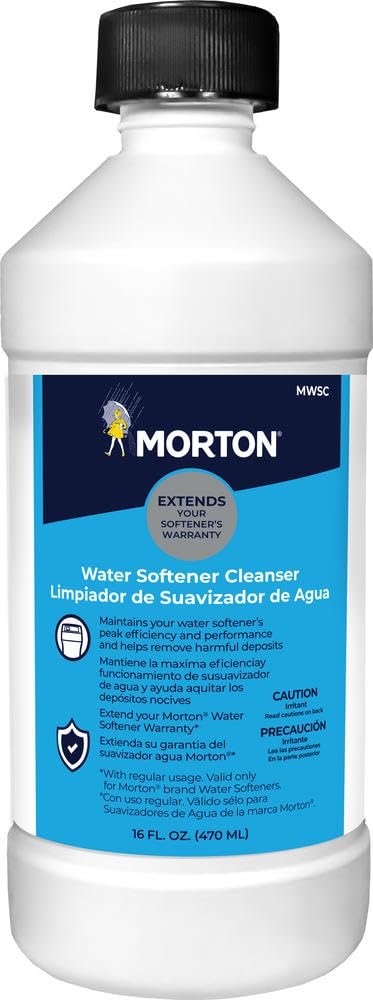
Morton MWSC Universal Water Softener Cleanser
The most-reviewed softener cleaner on Amazon at 1,737 reviews and 4.7/5. Compact 16oz bottle — right if you want to try a resin cleaner before committing to a gallon, or if your well has only light iron and you're cleaning monthly rather than biweekly. Morton's universal formula targets iron, rust, and sediment and is compatible with all major softener brands including Fleck, Kinetico, SpringWell, and US Water Systems.
Size
16 oz
Treatments
~1 (well water dose)
Price
~$24
Reviews
1,737 (4.7★)
Target fouling
Iron, rust, sediment
Compatibility
Universal
Buy this if: You want the highest-reviewed option to start with, or your iron is under 1 PPM and you're supplementing an iron filter that's already catching most of the load. For iron above 2 PPM on a biweekly schedule, upgrade to the Res-Up gallon — the per-treatment cost on 16oz bottles adds up fast.
Check Price on Amazon →3. EcoPure EPCL — Best Budget 16oz

EcoPure EPCL Universal Water Softener Cleaner
Third-highest review count in this roundup at 1,165 reviews and 4.7/5. Priced lower than the Morton at around $20 for a 16oz bottle — the cheapest entry point with a serious review base. Same iron, rust, and sediment targeting as the other liquid cleaners. Universal compatibility. The strong chemical smell reviewers mention is normal for phosphoric acid-based cleaners — use in a ventilated space.
Size
16 oz
Price
~$20
Reviews
1,165 (4.7★)
Target fouling
Iron, rust, sediment
Compatibility
Universal
Odor note
Strong — ventilate
Best use case: You want the lowest-cost entry with a proven review base. Good first purchase before deciding whether to switch to the Res-Up gallon for ongoing biweekly maintenance.
Check Price on Amazon →4. Pro Products ResCare 3 Gallon — Best Bulk Buy
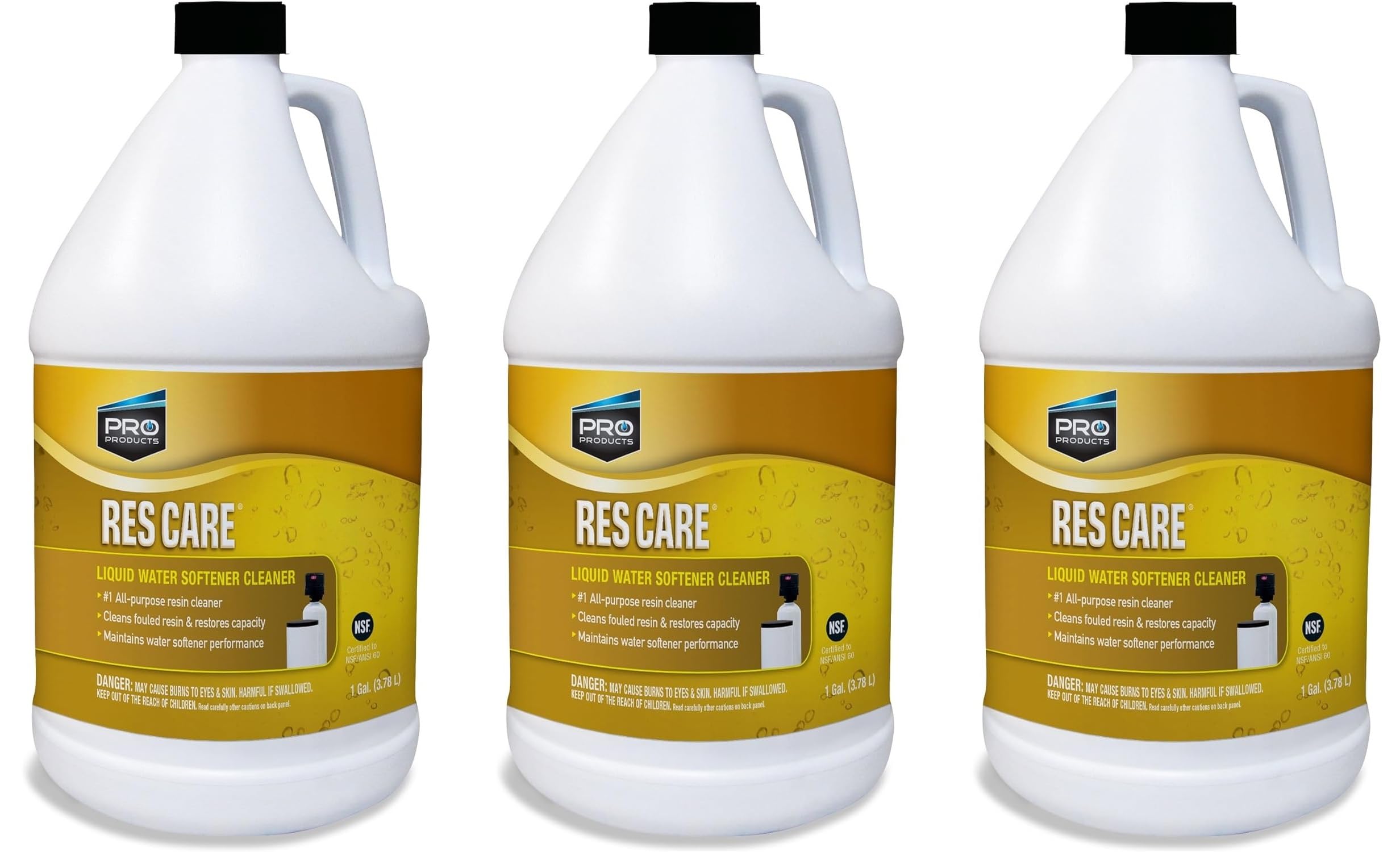
Pro Products ResCare RK02B (3 Gallons)
Three gallons of the same ResCare formula used by water treatment professionals — 384 oz total, enough for approximately 24 biweekly treatments. At $59.97 that works out to roughly $2.50 per treatment, the lowest cost per use in this roundup. Highest rating of any product here at 4.8/5 across 609 reviews. Compatible with Easy Feeder for automatic continuous dosing.
Size
3 gallons (384 oz)
Treatments
~24 (at 16 oz each)
Price
~$60
Reviews
609 (4.8★)
Cost per use
~$2.50
Auto feeder
Compatible
Best use case: Established biweekly routine, iron above 2 PPM, or if you have an auto feeder installed. At ~24 treatments per 3-gallon pack you're stocking roughly a year's supply for a single well water softener. Storage in a cool, dark area is fine — the formula is shelf-stable.
Check Price on Amazon →5. Pro Products ResCare Kit + Auto Feeder — Best for Set-and-Forget

Pro Products ResCare Resin Cleaner Kit with Easy Feeder
64oz of ResCare plus a non-electric Easy Feeder that mounts to the softener and automatically meters a small dose into each regeneration cycle. No manual pouring required after setup. Particularly valuable for pump house installs where the softener isn't convenient to access every two weeks — the feeder handles dosing without any scheduled intervention.
Includes
64 oz + Easy Feeder
Price
~$55
Reviews
65 (4.5★)
Install
DIY, non-electric
Target fouling
Iron, silt, organics
Refill with
ResCare 3 Gal bulk
Best use case: Pump house or remote install where biweekly manual dosing is inconvenient. Once installed, refill the feeder reservoir periodically with the 3-gallon bulk pack above. Lowest long-term maintenance burden of any option in this roundup.
Check Price on Amazon →6. OUT Filter Mate — Best Powder Format

OUT Filter Mate Water Softener Cleaner and Salt Booster (2-Pack, 24oz each)
506 reviews at 4.5/5. Citric acid-based powder formula — a different chemistry from the phosphoric acid liquid cleaners above. Works particularly well on limescale and mineral deposits, and the powder can be layered between salt bags so it cleans gradually with each regeneration rather than requiring a separate treatment step. Useful as a supplement to liquid resin cleaning rather than a replacement.
Format
Powder (citric acid)
Includes
2 × 24 oz bottles
Price
~$28
Reviews
506 (4.5★)
Target fouling
Iron, lime, mineral
Application
Layer with salt
Best use case: A supplement to your liquid resin cleaner, not a replacement. Layer the powder between salt bags at each refill so a maintenance dose goes in passively with every regeneration. Particularly good for hard wells where limescale is as much an issue as iron fouling.
Check Price on Amazon →7. Ban-T Alkaline — Only Pick for Tannin Fouling

Ban-T Alkaline Water Neutralizer and Cleaner (24oz)
150 reviews at 4.6/5. The only pick in this roundup formulated specifically for tannin fouling — the organic staining from decaying vegetation that's common in shallow wells, wells near wetlands, or wells in high-organic-soil areas. Tannins cause yellow-brown water color and an earthy smell, and they foul resin through a different mechanism than iron. Standard iron cleaners (Res-Up, Morton, EcoPure) don't address tannin fouling effectively. Ban-T does both.
Size
24 oz
Price
~$22
Reviews
150 (4.6★)
Target fouling
Tannins, iron, lime
Unique to
Tannin removal
Use with
Res-Up or Morton
How to know if you need this: Yellow or tea-colored water, earthy or musty smell, brown staining on fixtures that isn't rust-colored. These are tannin symptoms. If your water looks orange and smells metallic, that's iron — use Res-Up.
Use alongside an iron cleaner: If you have both iron and tannins (common in shallow wells near organic-rich soil), rotate — Ban-T monthly, Res-Up biweekly. Technicians in tannin-heavy areas often recommend Ban-T specifically for backwash treatment.
Check Price on Amazon →How to use resin cleaner correctly in a well water softener
Pour into the brine well — not onto the salt
The brine well is the small white or gray tube inside the salt tank. Remove the cap, pour the cleaner in, replace the cap. Pouring directly onto salt means the cleaner dilutes slowly and unevenly over multiple regeneration cycles instead of delivering a full dose in one treatment.
Trigger a manual regeneration or schedule one within 24 hours
Don't leave the cleaner sitting in the brine well without running a regeneration. The treatment needs to be drawn through the resin bed to work. On a Fleck 5600SXT, hold the Regen button for 3 seconds to trigger an immediate regeneration. On a MatriXX, use the Legacy View app's "Regenerate Now" button.
Do it every two weeks for well water with iron
This is the frequency from US Water Systems, Kinetico, and most well water service technicians. The label says monthly or quarterly — that's for city water. Well water with iron fouls resin faster. Biweekly cleaning prevents accumulation rather than trying to reverse heavy fouling.
Don't use strong oxidizing cleaners like bleach or chlorine tablets
Chlorine above 2 PPM degrades softener resin over time. If you shock-chlorinate your well, bypass the softener during the treatment and run several regenerations after the chlorine has flushed from the system before putting the softener back in service.
Common questions
Will resin cleaner fix hard water breaking through my softener?
Maybe — but diagnose first. Check salt level, check for bridging (hollow spot under the salt), verify your programmed hardness includes iron compensation. If all those are correct and you still have hard water, iron fouling is likely the cause — start a biweekly cleaning routine and you should see improvement over 2–4 regeneration cycles. If the softener is several years old and was never cleaned with iron in the feed water, the resin may need replacement rather than cleaning.
Is Res-Up the same as ResKleen?
Different brands, same concept. ResKleen is the US Water Systems branded product included with FleXX and MatriXX softeners. Res-Up is made by Pro Products. Both are phosphoric acid-based and address iron fouling. The Res-Up gallon is significantly more economical for biweekly use than buying individual ResKleen bottles.
My water has tannins and iron — which cleaner do I use?
Rotate both. Use Res-Up (or Morton or EcoPure) biweekly for iron fouling, and add Ban-T monthly for tannin treatment. They target different fouling mechanisms and work together. Signs of tannins: yellow or tea-colored water, earthy smell, brown non-rust staining. Signs of iron: orange staining, metallic taste, orange-tinted water.
Can I use resin cleaner in a Kinetico softener?
Yes — Kinetico recommends resin cleaning for well water installations. Use the same biweekly schedule and pour into the brine well before a regeneration. Because Kinetico systems use demand-initiated regeneration rather than a fixed schedule, you may need to trigger a manual regeneration after adding the cleaner rather than waiting for the next automatic cycle. Contact your Kinetico dealer if you're unsure of the manual regeneration procedure for your model.
Related guides
- Water softener maintenance guide — full schedule for well water
- Best water softener salt for well water
- Water softener for well water with iron — setup and iron compensation
- Fleck 5600SXT review
- FleXX vs MatriXX — US Water Systems combo comparison
- Iron filter for well water — reduce the load on your resin