The water quality result is identical. The decision is about operational intelligence.
Choose FleXX ($3,790) if...
- Softener is in an accessible utility room
- Iron is under 4–5 PPM
- Power grid is reliable
- Budget is the primary factor
Choose MatriXX ($4,740) if...
- Softener is in a pump house or outbuilding
- Iron is above 4 PPM
- Power outages are frequent
- Light commercial / agricultural use
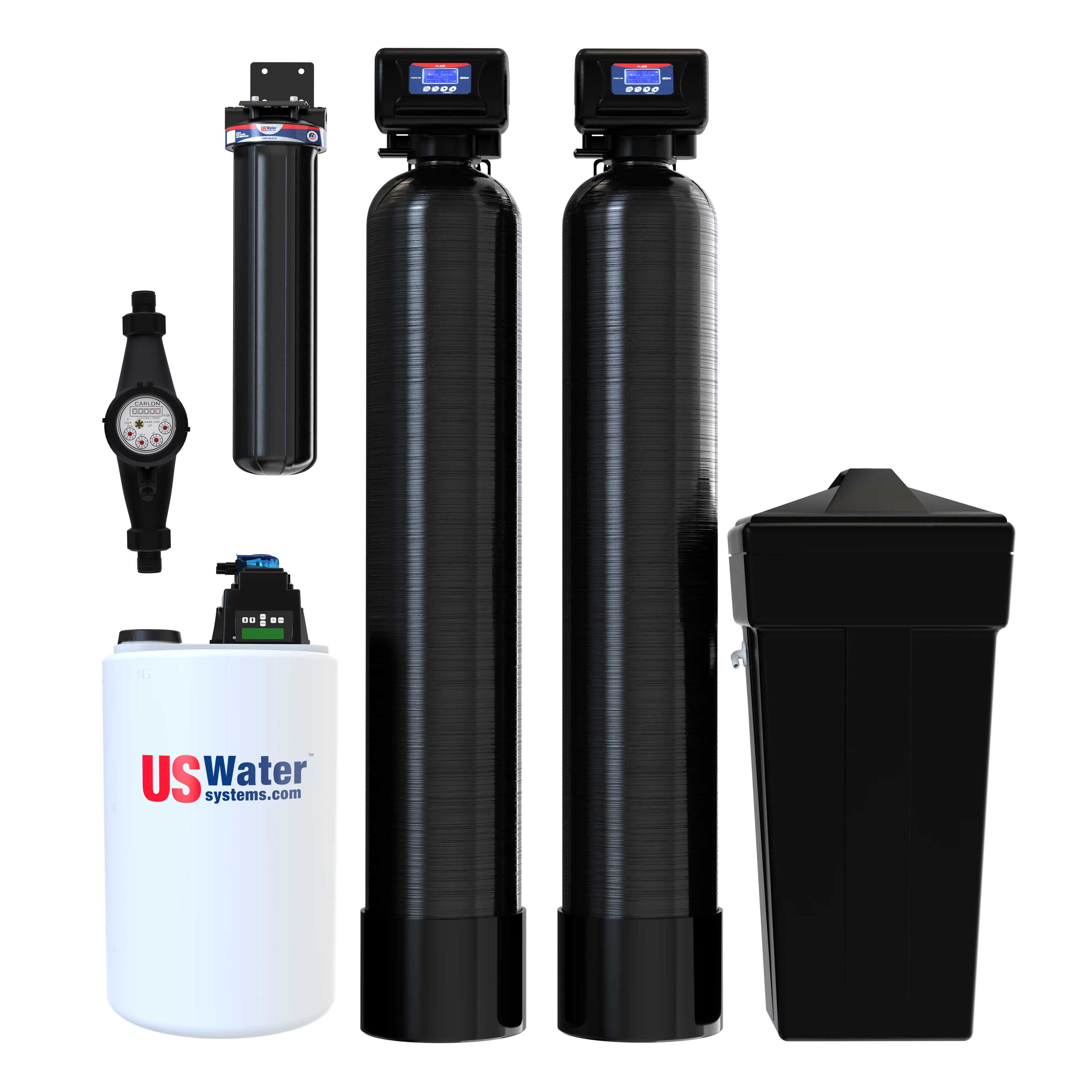
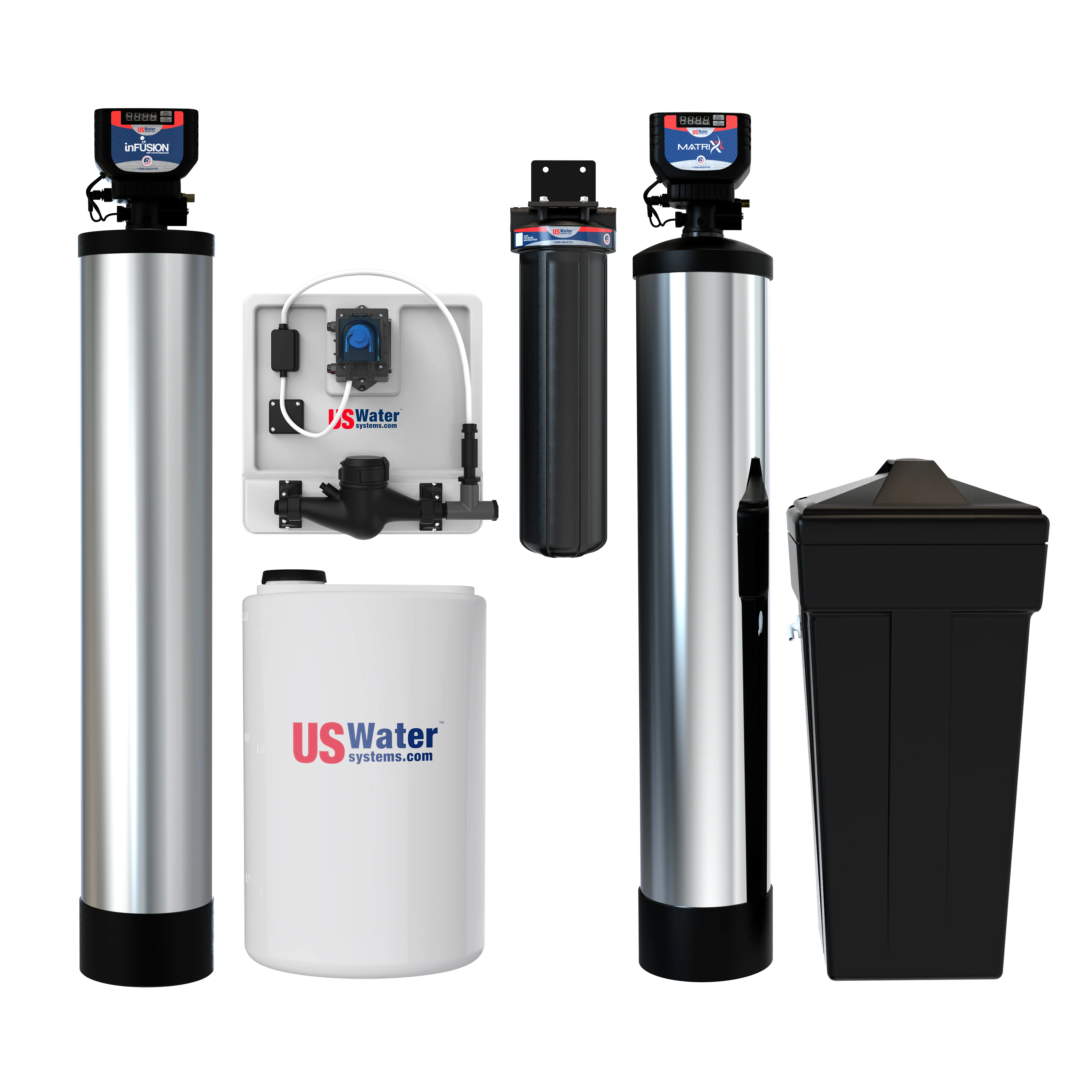
What they share — the parts that are identical
Before comparing the differences, it helps to be clear about what doesn't change between these two systems — because the core water treatment capability is completely identical.
The point: if you installed both systems side-by-side and tested the output water, you would not be able to tell the difference. The treated water is the same. Everything that follows is about managing and protecting that treatment system — not changing what it delivers.
The 7 features only the MatriXX has
Bluetooth monitoring — Legacy View app
The free Legacy View app (iOS/Android) gives you a full dashboard on your phone: current flow rate in GPM, gallons remaining until regeneration, total gallons treated, daily usage history, total regeneration count, and battery status. You can trigger a regeneration, change any setting, or sync the clock — all without going to the unit.
Who this matters for
Softener in a pump house, basement, or outbuilding more than 30 feet from the main house. Without the app, status checks require a site visit. With it, a glance at your phone tells you whether the system regenerated last night, how many gallons are left, and whether the flow meter is showing any anomalies. For an accessible utility room you walk past daily, this is a convenience. For a remote pump house, it's the difference between catching a problem early and discovering it when water turns hard.
9V battery backup
The MatriXX includes a standard 9-volt alkaline battery backup. During a power outage, the battery holds the clock so regeneration scheduling survives without a manual reset. If power fails mid-regeneration, the valve motors to a safe hold position and resumes the cycle when power returns. The FleXX has no battery — every power outage requires a manual time reset, and a mid-regen outage leaves the valve at whatever position it stopped.
Who this matters for
Rural well owners in areas with frequent grid interruptions — thunderstorms, ice storms, grid maintenance. A power outage at 2 AM means the regeneration doesn't run, the resin isn't recharged, and you wake up to hard water. The battery costs $1–2/year to replace. Over a 10-year ownership period, that's the most cost-effective insurance in the comparison.
Error code diagnostics (Err 2–6)
When something goes wrong with the MatriXX control valve, the display shows a specific error code: Err 2 (searching for home position), Err 3 (encoder not detected — piston debris), Err 4 (can't find home — encoder issue), Err 5 (motor overload — worn seals), Err 6 (no motor current — cable disconnected). Each code has a documented first-response step. The FleXX has no error codes — any malfunction requires a call to US Water Systems support to diagnose by symptoms.
Who this matters for
Anyone who would rather self-diagnose a problem than wait on hold for support. In a remote pump house, an Err 5 (motor overload) tells you to check the seals before replacing the whole control head — potentially saving hundreds of dollars. Without error codes, the next step is always a support call or a technician visit.
3-position dual-handle bypass valve
The FleXX has a single-handle bypass with two positions: service and bypass. The MatriXX has dual blue handles with three positions: Service (water through softener), Bypass (water around softener, house still supplied), and Off (water to softener completely isolated). The Off position is specifically useful for annual well shock chlorination — chlorine above 2 PPM destroys softener resin, and the Off position provides complete isolation without shutting off house water.
Who this matters for
Wells that require annual shock chlorination — which is most wells that have had bacteria or iron bacteria issues. The FleXX's two-position bypass allows basic isolation, but the MatriXX's dedicated Off position provides cleaner, more complete isolation for service work. Also useful if the control head needs to be replaced — the unit can be isolated without cutting off house water.
Stainless steel mineral tank option
The MatriXX is available with a stainless steel mineral tank as an upgrade. The FleXX uses polymer-wrapped fiberglass (the black tanks visible in the product image). Stainless offers superior corrosion resistance in high-humidity environments — pump houses, agricultural outbuildings, crawl spaces — where the combination of salt air, condensation, and proximity to well equipment accelerates surface degradation of standard tanks.
Who this matters for
Pump house installs, coastal properties, and agricultural facilities where humidity and environmental exposure are higher than a standard utility room. The polymer tanks are adequate for protected installations — this is not a concern for most residential utility room setups.
10-year parts warranty + lifetime resin warranty
The FleXX carries a 7-year parts and electronics warranty with no explicit lifetime resin coverage. The MatriXX carries a 10-year parts and electronics warranty plus a lifetime warranty on the polystyrene resin — explicitly stated in the manual. For well water with iron, this distinction is financially significant. Iron gradually fouls softener resin, reducing exchange capacity over time. Resin replacement — media plus labor — is a substantial expense. The MatriXX's lifetime resin warranty covers that risk if the system is properly maintained (biweekly ResKleen).
The math on iron-heavy wells
At 4+ PPM iron, resin fouling is a real long-term risk even with regular cleaning. A full resin replacement on a 1.5 cu/ft system can cost $200–$400 in media plus labor. The MatriXX's lifetime coverage eliminates that risk. Over a 10–15 year ownership period, this warranty differential is financially material for iron-bearing wells.
Explicit Maximum settings tier for very hard water
Both systems offer High Efficiency and Optimal operating tiers. Only the MatriXX explicitly documents a Maximum settings tier — with specific salt dosing, water usage, and grain capacity figures for each model size. The MXX-200 at maximum handles 64,000 grains using 30 lbs of salt per regeneration. The FleXX can technically reach similar capacity with higher salt dosing, but it isn't documented or supported as a named operating mode. For very hard wells (above 30 GPG) or wells with significant iron requiring heavy compensated hardness settings, the MatriXX is the better-documented and supported choice.
Who this matters for
Wells with tested hardness above 25 GPG or combined iron + hardness that pushes the compensated programming above 35 GPG. These are demanding water conditions where the extra headroom in the Maximum tier — and US Water Systems' explicit support for those settings — provides meaningful operational confidence.
Iron compensation programming — identical on both systems
Both systems require the same hardness compensation formula to account for iron in the feed water. The MatriXX manual documents it more explicitly, but the calculation and result are the same:
The formula
- Test water hardness → convert ppm ÷ 17.1 = GPG
- Test iron and manganese content (PPM)
- Iron/Mn compensation: (iron PPM + manganese PPM) × 4 = additional GPG
- Add 5 GPG seasonal buffer
- Programmed hardness = Step 1 + Step 3 + Step 4
Example: 18 GPG hardness, 3 PPM iron, 0.5 PPM manganese
Iron + Mn compensation: (3 + 0.5) × 4 = 14 GPG. Total: 18 + 14 + 5 = 37 GPG programmed hardness — even though tested hardness is only 18 GPG. Without this compensation, the resin exhausts far faster than expected and hard water breaks through between regenerations.
Key difference: on the MatriXX, you can adjust this remotely via the Legacy View app after annual water testing. On the FleXX, you walk to the unit and press buttons.
Which to choose — by scenario
Rural family home — moderate hardness, iron under 3 PPM, utility room install
→ FleXXYou'll check the system when you do laundry or grab the water heater shutoff. Salt level is visible when you open the tank. Moderate iron won't aggressively foul the resin. The $950 saved is better spent on a good annual water test and a few extra bags of ResKleen.
Rural home — high iron (4–7 PPM), hardness 20+ GPG, softener in pump house
→ MatriXXHigh iron pushes the resin hard — the lifetime resin warranty is meaningful here. The pump house location makes remote monitoring the difference between catching a failed regen and driving out in January to figure out why the water's gone hard. Get the stainless tank if the pump house is damp.
Vacation property — seasonal use, moderate water, accessible utility space
→ FleXX (or MatriXX for remote visibility)Metered regeneration on either system handles light seasonal use efficiently — no wasted salt during unoccupied periods. If you want to check system status from your primary residence before driving out, the MatriXX app makes that possible. If you'd just check it when you arrive, the FleXX saves you $950.
Small agricultural operation or light commercial — well-fed processing water
→ MatriXXVariable daily usage benefits from metered demand regen. The Valve Exchange Program ($89.95 for a reconditioned control head) minimizes downtime if the valve fails — relevant when water quality affects production. The 10-year warranty provides commercial-appropriate coverage. App monitoring gives usage history useful for compliance tracking.
Rural area — frequent power outages, any install location
→ MatriXXEven in an accessible utility room, frequent outages with the FleXX mean frequent manual time resets and missed regenerations. The battery backup pays for itself in convenience. A $1/year battery is the cheapest feature in this comparison by a wide margin.
Complete side-by-side
Common questions
Can I upgrade a FleXX to a MatriXX later?
Not directly — the control head and valve components are different and not interchangeable. If you buy a FleXX and later want Bluetooth monitoring or battery backup, you would need to replace the softener unit entirely. If remote monitoring is even a possibility you might want in the next 5 years, buying the MatriXX now is cheaper than replacing the FleXX later.
Does the MatriXX app require Wi-Fi or a data connection?
The Legacy View app connects to the MatriXX via Bluetooth — it does not require Wi-Fi at the softener location. You need to be within Bluetooth range (typically 30–50 feet) to communicate with the unit. The app does not provide remote monitoring over the internet; it's local Bluetooth only. This is sufficient for checking status when you're in or near the pump house but not from your living room or while away from the property.
Do I need to test my water before choosing a size?
Yes — hardness and iron levels determine which model size (100/150/200) you need. A 4-person household at 18 GPG hardness with 2 PPM iron needs a compensated setting of 31 GPG. At that hardness and typical daily usage, the FXP-150 or MXX-150 handles it comfortably. At 30 GPG hardness or above, or iron above 4 PPM, size up to the 200 model. See our water testing guide before buying either system.